Forum discussion

NC-v4.1 EQc7:Daylight

Daylight & Views – Simulation Approach for New Construction with Phased Core & Shell (Temporary Conditions vs. Final Design)

Hi all,

I’m looking for guidance on how to approach Daylight and Quality Views simulations under LEED v4.1 BD+C: New Construction for a higher education project with a partial core & shell phased delivery.

Project context:

  • Higher education building designed with strong daylighting strategies (central atrium, open circulation, etc.).
  • Due to budget constraints, the client is proceeding with a phased core & shell approach, with approximately 25% of the building shelled (so still qualifying as New Construction).
  • The shelled portion includes the central atrium, which is a primary daylight source.
  • At initial occupancy, the client plans to install temporary walls to separate the unfinished core/shell areas from occupied spaces.
  • These temporary partitions will significantly limit daylight penetration and views compared to the intended design.
  • There is no defined timeline for completion of the shelled areas, but the intent is to finish them in the future once funding is available.

Main question:

  • Should simulations reflect the building as it will be at initial occupancy (including temporary partitions that block daylight and views)?
  • Or can we model the final design intent (i.e., fully built-out atrium with no temporary barriers), given that the shelled areas are planned to be completed at some undetermined future phase?

Thanks in advance!

0

You rely on LEEDuser. Can we rely on you?

LEEDuser is supported by our premium members, not by advertisers.

Go premium for $15.95  »

Tue, 03/24/2026 - 16:51

Hi Kate, I don't understand how an atrium could be close enough to provide daylight and views, but far enough away that it could be shelled relative to the phase 1 occupied area. Wouldn't the atrium mostly serve the adjacent shell area, not the phase 1 area? It would help if you could provide a plan. Setting that aside, for a NC building with no definitive timeline to occupy that part I would normally exclude the shelled part from the regularly occupied area. Often shell expansions are delayed for several years or change when executed, so GBCI reviewer is unlikely to be convinced. One suggestion is to consider temporary partitions that allow view through to the shell space. If that's not acceptable, some kind of translucent material-- i.e. polyethylene sheeting--in the temp partition could help transfer some daylight. There may be other avenues such as a letter from owner promising to install it within 5 years. Do you have the ability to set up a pre-submission call with USGBC/GBCI to ask this question?Best,Collin

Tue, 03/24/2026 - 17:03

I agree with Colin above about contacting GBCI with your question (emailing them works). Many of our projects have tenanted spaces that will be built out albeit in shorter, defined timeframes, and we have been able to submit the final plans with a letter from the owner that confirms their development. 
LEED LI #10102 has additional guidance.

Mon, 03/30/2026 - 16:57

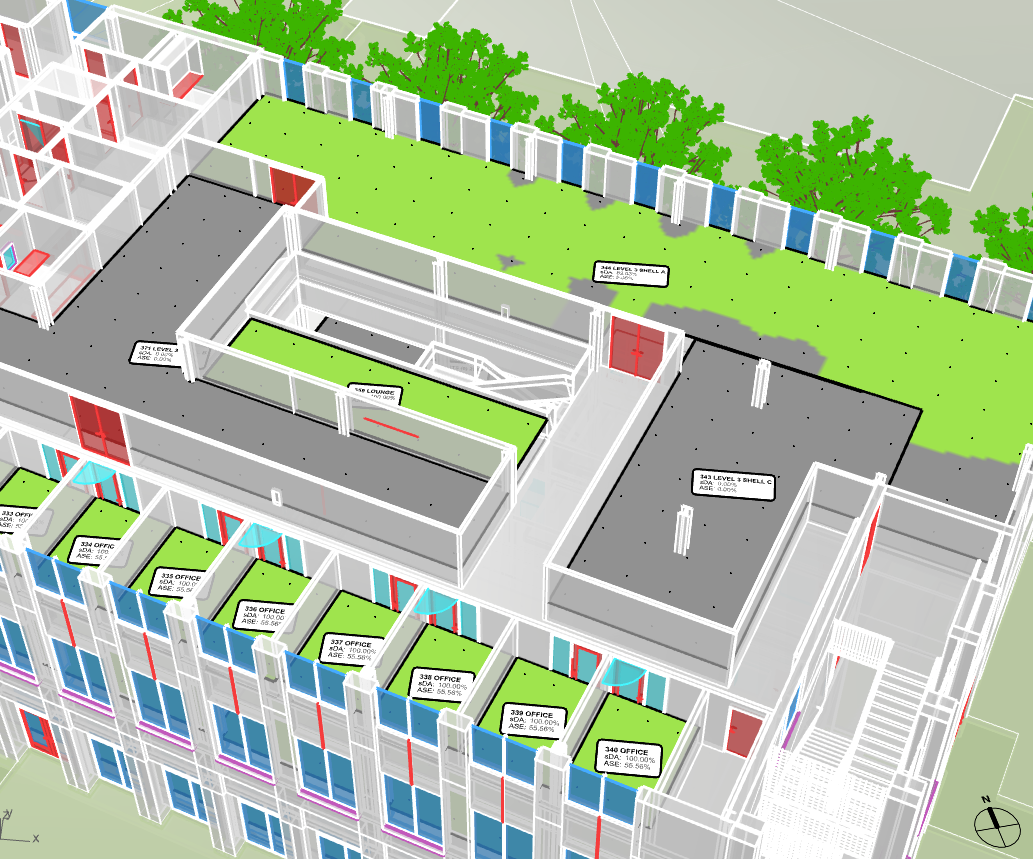
Hi Collin and Deborah,Thank you for your feedback. We decided to move forward with running simulations on how the design will be once it opens (the partial shelled space version). Collin, the original design was a large monitor skylight that was over a staircase and was helping bring light into the regularly occupied space around it.Regarding what to model now, you said you would exclude the shelled part from the regularly occupied area. Would that be the case even if in the future it will be some form of regularly occupied area like offices? I thought I have seen some scenarios where you make assumptions that a portion of of the shell space would be regularly occupied and the other portion might be a hallway or something to exclude. We are also pursuing the innovation credit daylight for non regularly occupied spaces. If we don't include the shelled spaces at all in the regularly occupied study, do they go in the non regularly occupied study instead? Or just excluded all together from both. I attached a screenshot of the main area I am unsure how to model. Shell A, B, and C are technically blocked off from access until funding is available to finish them. You can still take the stairs up to access the lounge and office spaces. Originally, there weren't all the walls around the stair case because it was open office area / other offices for the light to reach. Thank you, 

Mon, 03/30/2026 - 19:47

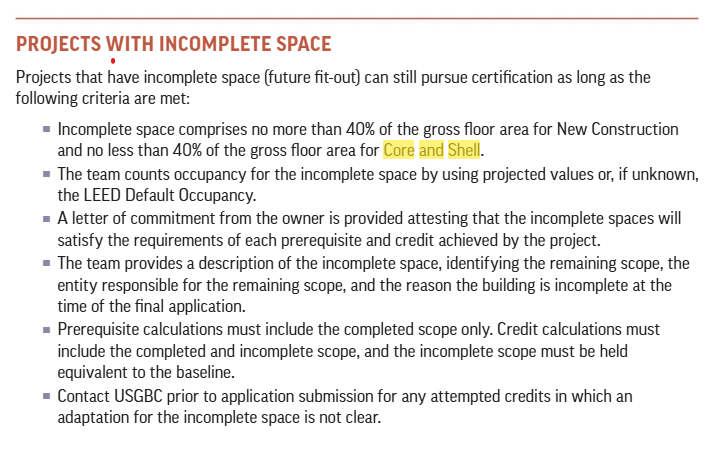
Hi Kate, OK this view is very helpful to see. I think I understand what you're asking now. I thought you wanted current-phase spaces to benefit from borrowed light through the shell spaces separated by opaque temporary partitions, a tough question. Now I see you're asking if you should include and model the shell spaces as being daylit through clear or absent partitions as it will be in the final. I usually exclude shell spaces, but my experience has been with smaller portions that what you show. I basically sorted them as "unoccupied" for all EQ credits, so they wouldn't appear in regularly- or non-regularly occupied areas. In this case, I think it makes sense to ask to include the entire shell as "regularly occupied" category, constructed as they will be in the final. As such they don't hurt the daylight or views of any reg occ spaces I can see. In the distant past I used to exclude a circulation area around the core, so I know what you mean there, can't find a reference to that practice, however. According to credit language from v4, for Core and Shell: "Assume that the entire floor plate, except for the core, will be regularly occupied space." Seems reasonable to follow that for the shell spaces here.In v5 ref guide there is the following guidance for incomplete spaces. My colleagues say that ultimately you have to work it out with USGBC in writing, since each project is different. See image below. Best of luck! - Collin

Add new comment

To post a comment, you need to register for a LEEDuser Basic membership (free) or login to your existing profile.